THE INTELLECTUAL PROPERTY MYTH ABOUT BUILDING A BUSINESS ON SUBSTACK (AND EVERYWHERE ELSE)
KEY INSIGHTS
The most common copyright myth—that “automatic ownership” means automatic protection—gives creators a false sense of security when placing their work into the creator economy on Substack or anywhere else.
Copyright protects the creative work itself—your writing, art, music, choreo, and so on. Trademark protects the brand identity behind the work. Most creative entrepreneurs need both.
Federal copyright and trademark protections alone are not sufficient to protect creators based on how their work lives and moves in the creator economy. Only an integrated approach provides complete protection.
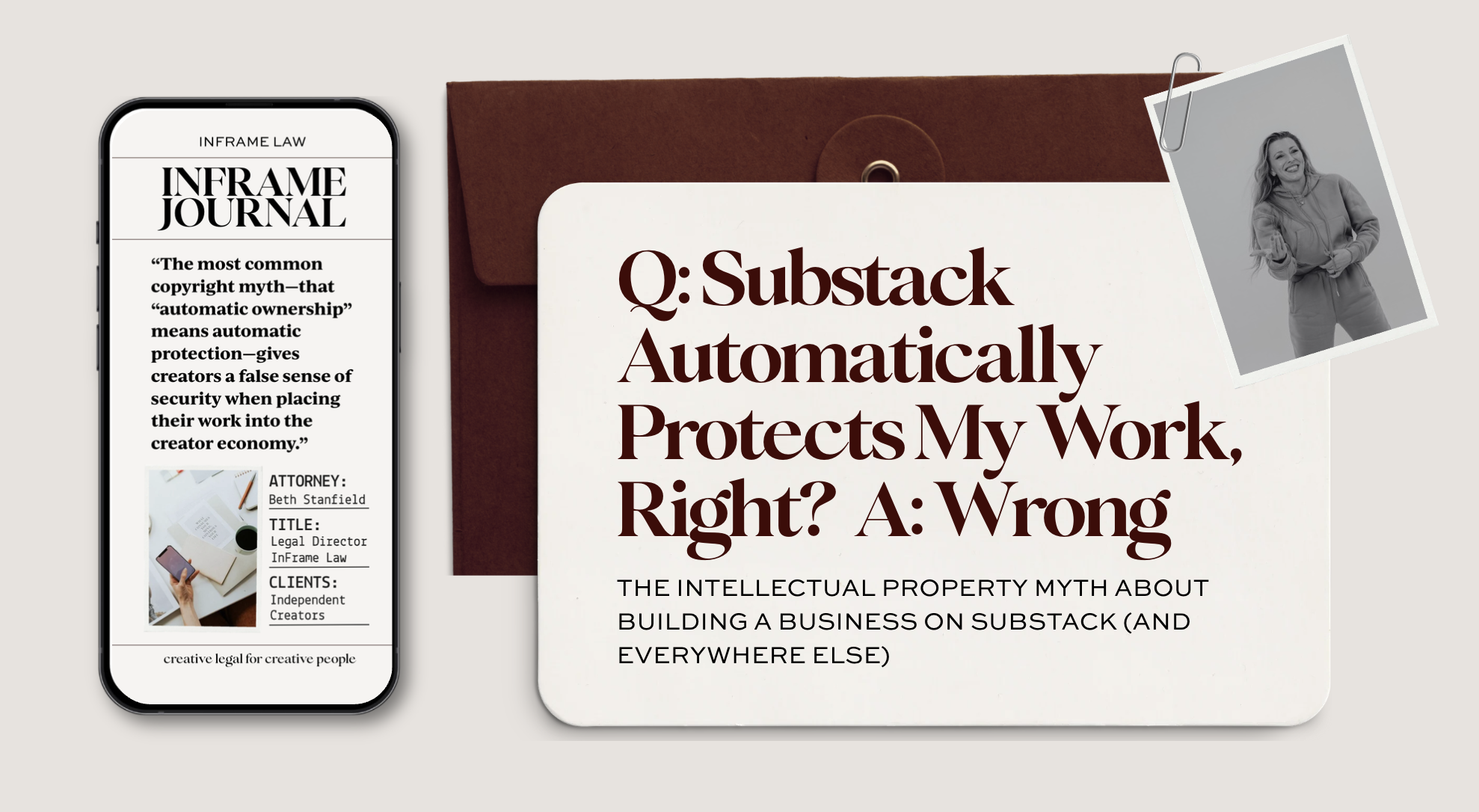
Substack Automatically Protects My Work, Right? Wrong.
A few months back, one of my long-time clients moved her monthly newsletter and membership community over to Substack. We were checking in on how its going—what’s working, what isn’t, what’s changed on the platform in the last week—the usual. Eventually, our conversation turned to the reason she reached out.
My client had recently learned that a member of her community had been sharing paid, subscriber only content to non-subscribers and using some of my client’s own writing without permission or attribution. After we walked through our three-step approach for handling incidents like this, we spent the rest of our time discussing how different the independent creator world is from the rest of the business world.
“If something like this happened when I worked in publishing,” my client explained, “we would just cancel the member’s subscription and move on, but now we’re talking about my own members and my own work. I can’t just ‘cancel’ anybody, and I can’t just ‘move on.’”
She was right. And I told her so—not just as an IP attorney, but a fellow creative entrepreneur navigating the same challenges in the same market. “The creator world is nothing like the corporate world—nothing,” I said. “And I had no idea until I went out on my own.”
“Yeah, it’s totally different,” she continued. “And confusing! Somewhere I read that everything I put on here is automatically protected under copyright, but what does that even mean? Not just legally—but practically?”
“I’m so glad we’re talking about this,” I told her. “You just articulated one of the most common myths about doing business on Substack. And not just Substack—pretty much all the other platforms too.”
WHY THIS MATTERS SO MUCH FOR CREATORS
Before we take the “automatic protection” myth down in three counts, I’m going to give you the world’s quickest summary of intellectual property (IP) law for creative entrepreneurs.
IP-101 FOR CREATORS IN 90 SECONDS
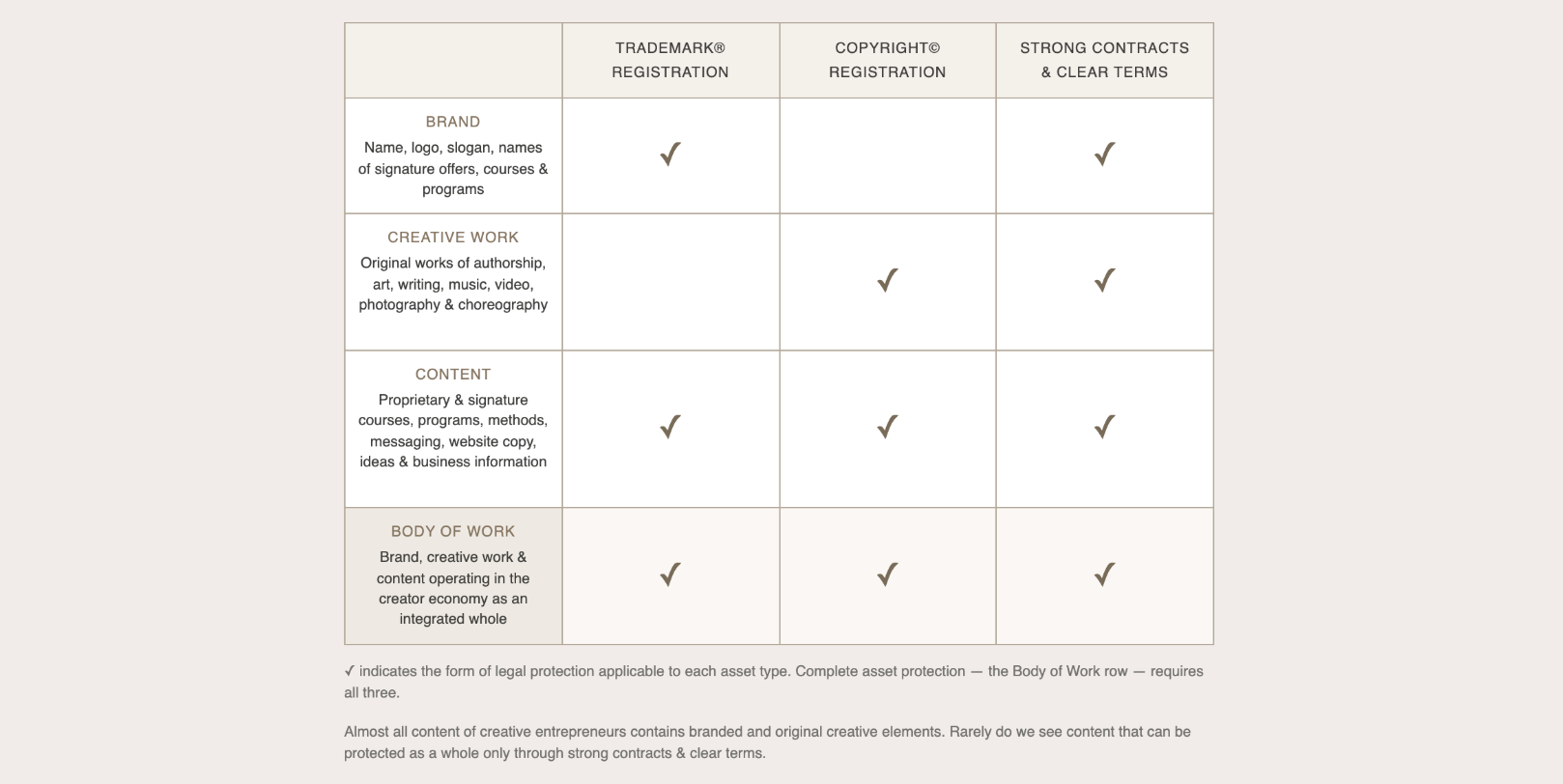
At the core of every creator’s business is their body of work. It’s their most valuable asset and the heart and soul of their business. But what makes the creator’s body of work so different from any other business asset is the way it operates in the creative economy. While it functions as an integrated whole, every creator’s body of work is actually made up of three types of IP assets—brand, creative work, and content.
In the U.S., these assets are protected through trademark, copyright, and contract law, but not the way it works for traditional businesses. This is because the creator’s body of work—and the assets contained within it—operate in constant, seamless motion over a multitude of platforms and applications. This means that protection for creators has to function as fluidly as their individual assets but as comprehensively as their collective body of work.
As an artist and an attorney, I need things to be verbal and visual to fully understand them. And since I work exclusively with creative entrepreneurs, I suspect the same might be true for you. So if my 90-second summary of IP law for creators left you with questions, I offer this lovely chart.
THE MYTH OF AUTOMATIC PROTECTION DEBUNKED
Let’s start with the part that’s true. Substack’s Terms of Use contain a short, but technically accurate statement about your rights in the original creative work you publish on its platform.
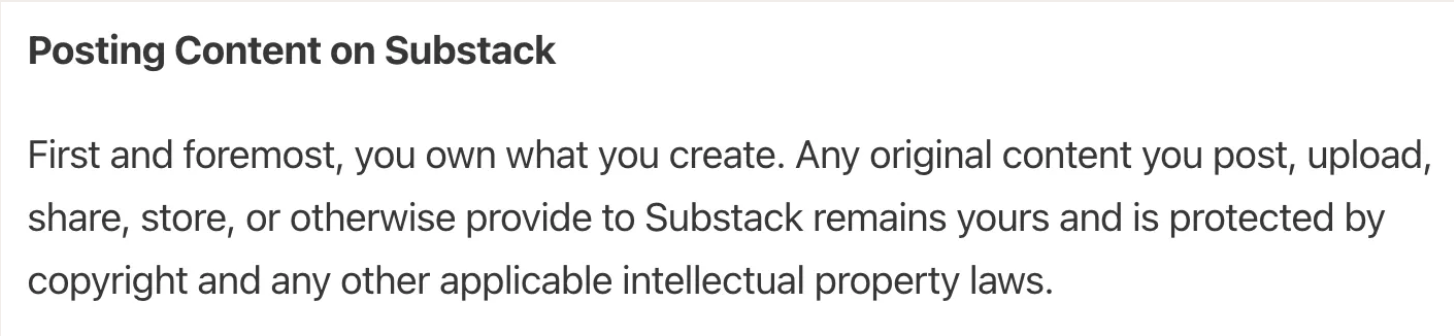
I am a strong advocate of plain english and brevity in legal language. However, this particular Term leaves much to be desired—not only in what is stated but what is omitted—leaving creators like my client predictably confused about what, if anything, is protected.
1. If You Made It, You Own It, But Nothing Else Is “Automatic”
First, it’s important to understand the limits of Substack’s power. The platform cannot give you anything you don’t already have and it doesn’t actually tell you anything you don’t already know.
Under U.S. law, ownership rights in original creative work attach at the time of creation. In the traditional legal world, we say this happens by “operation of law,” which is an unnecessarily circular way of stating the obvious. Basically we’re simply saying: “If you made it, of course it’s yours”—or, if you prefer Substack’s version: “You own what you create.” The point is, ownership rights in creative work aren’t coming from Substack or any legal authority, but from the act of creation itself.
It’s like being a parent. The two teenage boys living in my house don’t belong to me “by operation of law.” They’re “mine” because I’m their mom. The same is true for everything we produce creatively.
The problem is that Substack’s Term of Use doesn’t stop there. It goes on to tell users that everything they publish is “protected” by copyright and “intellectual property laws,” and concludes with no further explanation.
So how exactly is the work protected? They don’t say. Under what laws? They don’t say. Who is doing the actual protecting? They don’t say. How can users get answers to these questions? They don’t say.
I don’t believe Substack intended to confuse users or perpetuate the myth of automatic protection. I think they wanted to provide clear information without a mountain of legalese. But in doing so, I think they probably employed a team of attorneys to draft legal terms for a world that is totally foreign to them and for an audience they don’t serve or understand.
Nevertheless, the myth of automatic protection is especially problematic for creators because they rely on platforms built to serve the creative community but are left with a false sense of security about what those platforms actually protect.
2. No Platform Is Protecting Your Work
Here’s the whole truth. There is no automatic protection, I repeat—no automatic protection—for anything you publish anywhere. It doesn’t matter if it’s Substack, Instagram, TikTok, or anything else. No platform is protecting your work—not automatically, not partially, not at all.
However, when Substack’s Terms of Use tell you your work “is protected by copyright,” without any further clarification or information, the myth of protection is easy to understand.
If similar Terms of Use came with children, I would have thrown them out long ago (**the terms, not the children**). A statement confirming that the two teenage boys living in my house are “mine” does nothing to relieve me of my obligation to nurture and protect them, or help me track how they move about the world, interact with others, and chase their dreams.
The same is true for everything you produce creatively. If you create something original, it’s yours and yours alone. But it’s also yours alone to protect. No platforms are monitoring uses of your work, policing potential violations, or enforcing your rights. Tools for reporting fraud and abuse do exist, but they are extremely limited and largely ineffective in addressing real-world problems.
For example, when I discussed options with my client a few weeks back, no platform-based or statutory remedies were available to assist her. She had not yet secured trademark and copyright registrations and did not have clear language and contractual terms in place for her membership and subscriber-only content.
We formed a simple plan to close those gaps, but my client’s situation is not unique. Most creators I work with are similarly exposed, and it’s not because they’re naive or careless. It’s because the world of creative entrepreneurship is distinctly different than the traditional business world and the law firms that serve them. Creators don’t know what they don’t know because the people they’ve been listening to don’t know either.
3. Protection of Content Requires Protection of All IP Assets
The myth of automatic protection is demonstrated most clearly in what is omitted from Substack’s Terms of Use rather than what is stated. So far, we haven’t even discussed the title heading, and there’s a reason for that.
It’s called “Posting Content on Substack,” but the information that follows is not about content. It’s about only one type of IP asset—original creative work—and one type of legal ownership—copyright. Why is this?
→ Don’t they know that “content” isn’t just original creative work, but also includes brand and business assets that are not protected by copyright, such as business name, logo, slogan, name of Substack, course materials, programs, offers, and so many other proprietary assets?
→ Don’t they understand how content operates in constant motion across platforms and applications?
No. They don’t. They don’t understand creative entrepreneurs, the way we work, or the way our work operates in the creative world. Actual protection has to work for creators to work at all.
WHY INFRAME: Legal Protection Designed by Creators for Creators
InFrame Law protects the brand, creative work, and content of creative entrepreneurs. We do this through a single, affordable framework that integrates the trademark, copyright, and intellectual property services creators need to protect and position their work.
As a law firm built by creative entrepreneurs for creative entrepreneurs, we know what it takes to build an income-producing body of work in the creator economy. We know how that work operates over platforms and applications and how quickly and easily these assets can be copied, stolen, and misused.
Yet, no one is truly protecting creators’ work — not the platforms, not the applications, not the template shops, and definitely not the law firms. Creators are left to figure it out for themselves, leaving their most valuable assets completely exposed. Not because they’re careless or naive, but because the available legal “solutions” come from old-world approaches that cost a small fortune and do not work. We know this — not just from 20 years of legal practice, but as creators just like you.
This is Why InFrame. We provide the legal solution that didn’t exist until now — complete asset protection for your brand, creative work, and content, in one framework that places your body of work exactly where it should be.
Protected, Positioned, and InFrame.