Can Creators Still Claim Copyright for AI-Assisted Content?
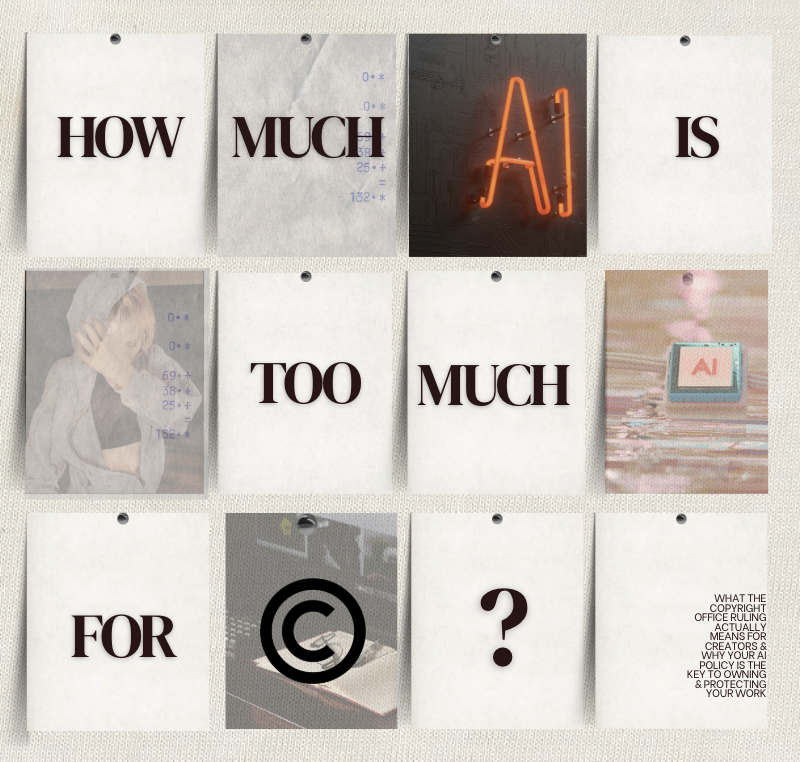
WHAT THE COPYRIGHT OFFICE RULING ACTUALLY MEANS FOR CREATORS & WHY YOUR AI POLICY IS THE KEY TO OWNING & PROTECTING YOUR WORK
KEY INSIGHTS
AI saves an average of 2.5 hours per day, making it one of the most powerful productivity tools for independent creators. However, many creators are not using AI correctly and losing ownership of their work.
The U.S. Copyright Office’s ruling did not prohibit all AI-assisted creative work, but whether creators retain rights in their work depends on how they use AI, how they document their use, and how they demonstrate “human expression” in the final product.
All creators need an AI policy, but they also need a framework they can actually follow to comply with U.S. law, secure ownership, and establish credibility in the creator economy.
A strange thing happens during my first call with new clients, and when it happens, it’s always during the same part of our call. It’s when I ask about AI use.
Suddenly, they get a little nervous and twitchy—like they’re doing something they know they shouldn’t be doing. Or like I’m their primary physician asking about their substance use. But I get it. Just like my clients, I’m a creative entrepreneur building a business in the creator economy with two seemingly opposed priorities:
➔ Producing a meaningful body of work without burning myself out; and
➔ Producing a meaningful body of work I can claim and protect as my own.
So when I tell clients how much AI-assisted work I’ve incorporated into my own creative process, they’re relieved. But also a little surprised. I think they expect me to give them a long list of legal risks and reprimands. I do not do this.
But I do tell them the truth. All options—using some AI, a lot of AI, or no AI whatsoever—are perfectly reasonable choices for creative entrepreneurs. The issue is how.
How do creators use AI without losing their credibility or their ability to own, copyright, and protect their work?
For creators, their ability to do this is a dealbreaker, but so many of my clients feel completely stuck—while many others are using AI in a way that cancels their legal rights without them even knowing it.
In this article, I’m going to explain what’s at stake, give you my 90-second summary of the core legal issues, and walk you through the framework I developed to navigate the line all creative entrepreneurs must navigate using AI in the creator economy.
EVERYONE IS USING AI
Well, first off, we know that’s not true.
Many of my clients have well-grounded philosophical, intellectual, and creative bases for opting out. And they’re not wrong.
I also have clients that immediately jumped into the deep, citing the inevitability of AI-assisted content generation, massive time-savings, and maintaining their competitive “edge” in the market. They’re not wrong either.
Most of my clients, however, are somewhere in between—not all-in, but not peacing out. But they’re feeling the pressure more than ever. In fact, with the explosion of AI tools in the creator economy just this past year, creators increasingly feel like they’re between a rock and a hard place.
On the one hand, the massive shift to AI in the creator economy was inevitable. Given the ease of producing high-quality content in minutes rather than hours, far more creators are using AI with far less reservation. And the data behind this shift is substantial. For independent creators producing content across multiple platforms, the time savings is quickly becoming the difference between sustainability and total overwhelm.
However, even clients who use AI liberally worry about how much they’re using and whether they’re doing it right. And they should be. As an attorney working exclusively with creative entrepreneurs, the trend is clear. Far too many creators are building robust bodies of work without understanding how much of that work they’re giving away.
HOW NOT TO USE AI
On the other hand, there is the obvious “ick” factor in using a high-powered computer program—fed with a steady diet of bad information, bad art, and questionable programming—to “generate” anything of authentic, creative value. After all, creators have chosen the path independent entrepreneurship for a reason: they’re not here to maintain the status quo but to challenge it—through their art, voice, and creative work. The problem is this:
Creators can’t fulfill their mission if their words aren’t being heard. And it sure seems like the only voices being heard are the ones generated by machines. That’s why it feels like everyone is actually using AI, and the ones who don’t are getting drowned-out in the market or simply left behind.
There is another reason many in the creative industry aren’t making the shift to AI, and it’s not the generalized “ick.” It goes to very heart and soul of their business—their artistic integrity, creative authorship, and ownership rights.
In early 2025, when the U.S. Copyright Office confirmed that AI-generated content will not be entitled to copyright protection, many of my clients felt completely stuck. As creators, retaining ownership rights in their work is an absolute deal-breaker. They’re willing to use AI if it helps them do things they could give to an intern or research assistant (if they had one), but they are not willing to sacrifice their credibility, integrity, or creative ownership to do so. Nor should they.
As an artist and business owner, I don’t believe any increase in platform, revenue, or time-savings attributed to AI is worth compromising my artistic integrity, creative authorship, and ownership rights. This is why I spent the last three years researching, testing, and training myself on AI in order to synthesize the two seemingly opposed priorities—
➔ Producing a meaningful body of work without burning myself out, and
➔ Producing a meaningful body of work I can claim and protect as my own.
The result is my four-step framework for using AI without placing your credibility, integrity, and ownership in jeopardy. But before we get to the framework, I’m going to give you my 90-second summary of AI law for creators.
MY 90-SECOND LEGAL 101 FOR CREATORS
Ownership of AI-Assisted Content
In Part 2 of the U.S. Copyright Office’s Report on Copyright and Artificial Intelligence, available here, the Copyright Office confirmed that content generated by AI programs will not be considered original works of authorship and will not receive copyrights. So an article produced by AI according to prompts, however detailed or thoughtful the prompts may be, will not be considered the original work of the prompter and will not be protected under federal law. The decision is not surprising. It’s rooted in the requirement of original human expression that has always been a bedrock for protection under U.S. Copyright Law.
However, if AI is only being used as a tool or resource during the creative process, copyright protection will depend on the degree of human expression used in the process and demonstrated in the final product. If sufficient human expression is not only present, but “perceptible,” in the final work, the creator can claim ownership rights and use the copyright © symbol beside the work. And that © symbol is a big deal for creators. It not only signifies ownership and protection, it’s a key component for establishing credibility and visibility in the creator economy.
For creators, the question then becomes:
What amount of “human expression” is sufficient, and how do creators navigate that line, track their movements, and demonstrate the “human expression” requirement in their final work product and documentation?
The answer to this question is our AI Policy and four-step framework designed exclusively for creators.
THE FOUR-STEP FRAMEWORK FOR USING AI
What I’m about to walk you through is the framework I developed to structure and protect my own work while using AI. It allows creators to use AI-based efficiencies, provides a step-by-step guideline forusing AI as a resource not a surrogate for human creativity, and pulls all the legal and commercial requirements together in an attorney-drafted AI Policy that serves as the foundation for all content.
STEP ONE: TAKE INVENTORY
Perform a simple inventory of your work following the categories outlined on our AI Policy Worksheet. Don’t overthink it. The goal here is to get a sense for the type of work you are producing and whether that work checks the box for one or more of the following asset types:
Your original creative work — protected by registered copyrights and enforceable terms
Your branding — protected by registered copyrights and enforceable terms
Your proprietary business content — protected by clear contracts and enforceable terms
➔ Our AI Policy Worksheet includes clear, easy-to-follow definitions and asset type examples to eliminate guesswork.
STEP TWO: TRACK YOUR USES
For every type of work entered in the AI Policy Worksheet for Step One, select any AI use based on how you use it (such as researching, outlining, drafting, refining, organizing, proofing, sourcing, formatting, generating or modifying images, photos, video, and other uses). Yes, this part is a little boring, but you only need to do this once, and it’s the cheat code for using AI without losing your legal rights. Plus, the worksheet helps you make better use of AI tools no matter how you’ve been using them.
➔ Our AI Policy includes simple definitions based on the way creators actually use AI in their work with each use clearly marked with a green light, yellow light, or red light for retaining all rights in your work.
STEP THREE: SELECT YOUR POLICY
With the information from Steps One and Two, you’ll open our attorney-drafted AI Policy and select the policy type and language that fits your work and your AI uses. Clear directions are provided throughout the policy and can be adjusted as often as your needs change.
That’s the beauty of our AI Policy. It’s not a generalized legal document—chockfull of legalese and dense technical paragraphs that no one even reads. It’s a clear, readable statement about the role AI plays in your work, how you use it, how you track your use, and how you demonstrate the requirement of human expression in the final product.
➔ Once selected, our Worksheet walks you through the process of implementing the AI Policy across your platforms, offers, courses, website, and other materials.
STEP FOUR: FOLLOW YOUR POLICY
When I say “follow” your AI Policy, I do not mean: Be aware of what it says and do your best to comply. I mean:
Do exactly what the AI Policy says you’re going to do.
The AI Policy serves as your protection, but it also serves as your promise to customers, readers, followers, and subscribers. It’s how you gain trust and credibility and is worth every minute of your precious time.
But this is where your work in Steps One and Two really pay off. The way you follow the policy is by turning the worksheet into a live tracking system, which is precisely what the worksheet was designed to do. The tracking system does four things:
Ensures that every piece of content you create and publish complies with the AI Policy;
Satisfies the documentation requirements outlined by the Copyright Office;
Complies with the rising number of platform disclosure requirements; and
Preserves your rights as the creator, author, and owner of your work.
➔ The AI Policy and Worksheet have everything you need to comply with current copyright law, with the added bonus of tracking your brand and business assets, which are equally important and totally overlooked in the AI discussion. But that’s another big discussion for another day . . . For now, start with the AI Policy as the foundation for your work.