What Trademark Registration Actually Costs Creators
THE REAL NUMBERS & THE 5-MINUTE EXPE®IMENT THAT SHOWS THE BIGGEST TRADEMARK COST
KEY INSIGHTS
Independent creators don’t need to be reminded about the legal risks of waiting too long to trademark their brand. However, most are not aware of what it actually costs to get a trademark registered and what it actually costs when they end up in a trademark dispute or forced rebrand.
We’ve researched this issue extensively and give you the actual, out-of-pocket costs involved when creators DO trademark and when they DON’T.
What creators need to know most of all is the hidden cost that far exceeds any others. This 2-minute TRADEMARK EXPE®IMENT will allow you to see it for yourself.
THE HARD COSTS OF TRADEMARKING . . . AND NOT TRADEMARKING
No one really needs to hear another version of the story—what can happen when independent writers, creators, and entrepreneurs don’t trademark. In fact, in the hundreds of convos I’ve had with creators, not a single one of them didn’t already know that federal trademark registration is essential for their business and brand.
Some of them also have a pretty good idea of what they risk financially by putting it off or waiting to hit some arbitrary benchmark before trademarking. But almost none of them understand the true cost of riding out into the wild, unregulated frontier we call the creator economy, day after day, with . . .
nothing definitive to distinguish the creator’s business from all the fakes; and
nothing to deter the copycats, content poachers, and AI programs from using their branded content before they even knows it’s happening.
And when it does happen, the average $10K loss is not only a conservative number, it’s nowhere close to the true loss. But before we get to that loss, let’s cover the ones I see everyday.
THE ACTUAL COST OF TRADEMARK REGISTRATION
If you’ve ever reached out to a TM attorney for a quote, they probably gave you an estimate based on either an hourly rate or a “flat fee” (air quotes because flat fee doesn’t always mean what you think it means). Either way, the average quote lands in the range of $2,500.00 to $3,500.00 for a single registration of a single mark. And for creators who are serious about building a long-term, income-sustaining business, the 2.5K to 3.5K investment easily pays for itself. However—
The devil’s in the disclaimers.
Every flat-fee provider has a robust list of things that aren’t included in the “flat-fee,” so even with firms advertising a “flat” 1.5K to 2K, the final all-in numbers are closer to most common range.
Before we launched InFrame Law, my business partner and I studied the pricing question exhaustively. We did this for two reasons. One—because we actually like nerding out on research; and two—because there is, in fact, a better way. (I don’t want to get sidetracked, so I’ll link my findings here.)
The bottom line is this: whether you go with an hourly-fee firm, a flat-fee (sort of) firm, or InFrame, the investment is 1000% worth it. (Just please don’t fall for the scams. They are very, very real and can snag very, very smart people.)
THE COST OF NOT TRADEMARKING
The Visible Cost
When a trademark conflict surfaces—whether from a cease & desist letter, platform takedown, or someone beat you to the trademark office—the fix is rarely a lowkey edit. It’s either a trademark dispute or a forced rebrand.
Trademark disputes vary widely in cost. A simple dispute that is quickly handled without litigation can be resolved for as little as 5K. But any dispute requiring demand letters, USPTO filings, or litigation will cost 10K—at a minimum.
I wish I could present a different number, but I’ve handled these cases for almost two decades, and 10K really is the minimum. IP litigation is EXPENSIVE, so an adversarial dispute can easily amount to 50K, 100K, 200K in legal fees alone. And in over 90% of these cases, the only “winners” are the lawyers.
The cost of a rebrand is more contained, but depends on the size of the business. A relatively new business (1 to 2 years old) with a low amount of expenditures on brand development (signage, printed materials, merch) can rebrand for less than 5K if the owner does most of the work. It’s closer to 10K with third party support (web developer, branding agency, etc.). For a business that is more established (2-3 years into business), a full rebrand costs anywhere from $15,000.00 to $75,000.00.
(If you’re curious about what a rebrand would cost you specifically, let’s do it over coffee. You can schedule it with this link.)
Otherwise, there you have it: the actual, quantifiable cost of trademarking and not trademarking. Now, let’s talk about the part that’s hidden.
The Invisible Cost
This is the part that is totally absent in the cost-benefit analysis—what creators actually lose when they don’t trademark. The reason it’s absent is because it’s invisible. It’s not based on numbers we can plug into a formula or a typical spreadsheet—unless that spreadsheet has a column dedicated to “OPTICS.”
Boy, I hate the word “optics.”
If you saw my face when I typed it, you’d probably ask if I was okay. And I would’ve said “Yes, I’m okay” but I’m not okay with what’s happening right now in the creator economy for real artists, real writers, real creators. The ones who chose the more difficult path of independent entrepreneurship because their creativity, mission, and gifts are too big and too valuable for the traditional workplace.
This is the community we serve at InFrame, and I love them. I love their brilliance and infinite creativity. I love their resilience and passion. But the truth is, they are terrible marketers. They spend hundreds of hours on their work, and almost zero hours making sure it’s visible. They spend thousands of dollars building their businesses, and almost zero dollars making sure that what they’re building is both safe and seen.
This is why NOT trademarking is especially damaging to creators. They understand the risks of failing to keep their work safe, but they don’t realize it also keeps them from being seen. And the actual loss the creator sustains is invisible because it makes the creator is invisible.
A few weeks ago, I was talking with an independent graphic designer / visual artist about trademarking and the optics (guh) of building business online. I’m paraphrasing, but his observations were on-point:
I think I’m finally in a place of acceptance. We can’t change the fact that optics matter more than quality, expertise, real art, and original thought. People are making decisions based on what they perceive from a 2-second scroll, so I have to find a way to play the “optics” game without sacrificing my work. Otherwise—what’s the point?
Well-put, friend.
THIS is why trademarking matters so much for entrepreneurs. Protection, yes—but also optics. And I want you to see it for yourself.
THE TRADEMARK EXPE®IMENT
This exercise will take you the same amount of time it takes your ideal customer to see your content, click your link, and look you up—or scroll to someone else.
Step One. Open a major platform app—LinkedIn, Instagram, Substack, etc.—wherever your ideal customer spends most their time. Scroll for one minute. Scan the feed for people or groups that are marketing their business, program, offer, event, or other promotional etc. Keep scrolling until you find the ® symbol next to the business name or other branded element. Jot down your initial impressions.
Step Two. Now do the same thing you did in Step One, except this time, take note of the businesses without any ® symbol, not even the “TM,”—just a name or program or offer that could have been invented yesterday. Jot down your impressions.
Step Three. Answer these questions honestly. In a contest between the business displaying the ® symbol and the business with no symbols, who’s getting your business? Obviously, no one is making that decision after a 2-minute scroll (at least I hope not), but for this exercise, you do. So who will it be? Whose content will you click? Whose website will you visit?
Do you see it now?
Back when I was partner at a large law firm, I advised countless clients on the power of trademark registration and the hard costs of waiting too long to do it. Never once did we discuss the optics or the enormous cost of being invisible. Now—over three years into entrepreneurship—it’s as clear as day. And it’s what I talk about to my people more than anything else. Because—
Trademarking—especially for independent creators—is a superpower.
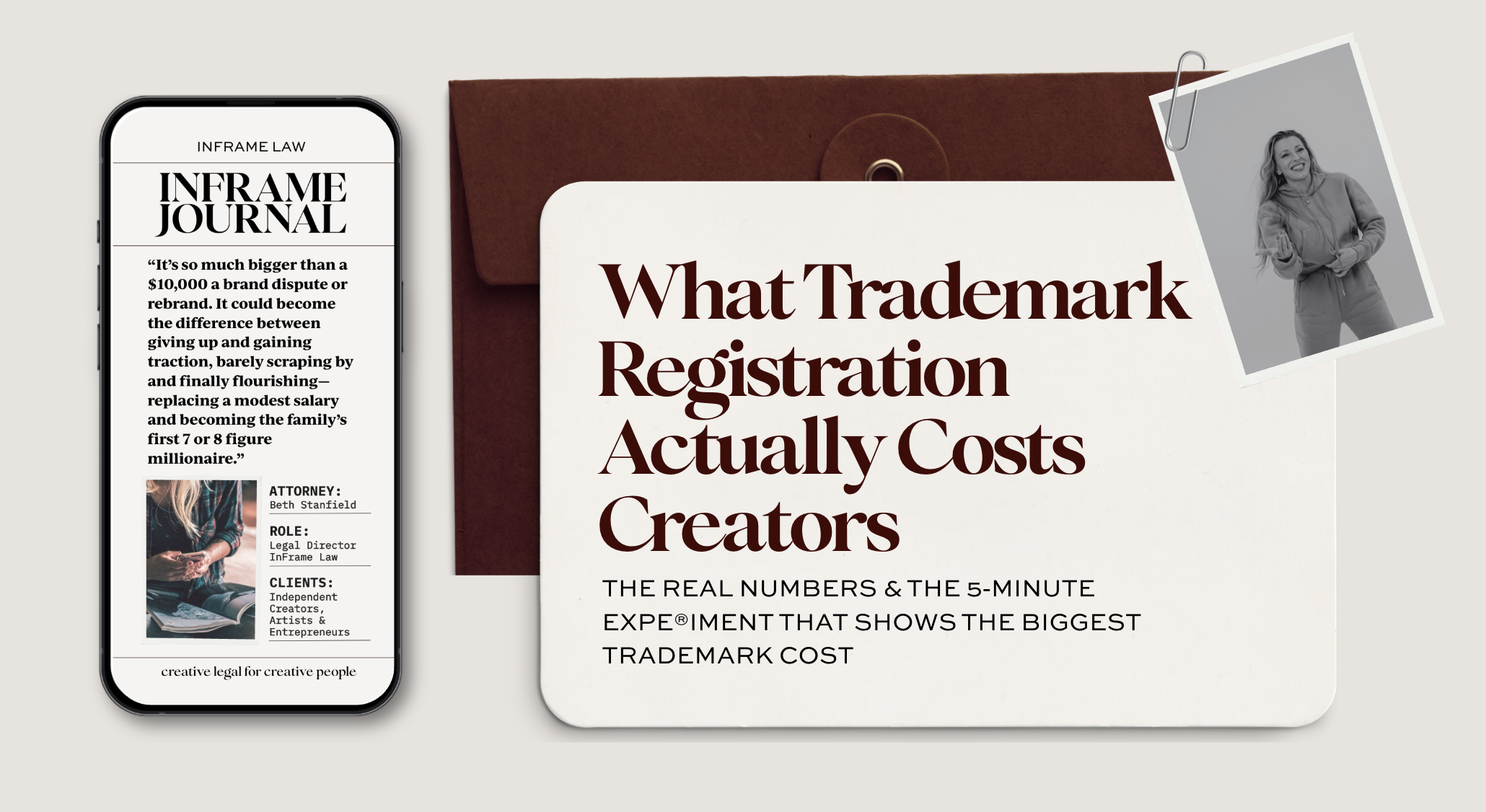
It’s so much bigger than a $10,000 a brand dispute or rebrand. It could become the difference between giving up and gaining traction, barely scraping by and finally flourishing—replacing a modest salary and becoming the family’s first 7 or 8 figure millionaire.
And it starts with one tiny symbol, one letter, and a one-second impression.
Trademark registration (and the street cred that comes with it) is one of the most cost-effective marketing tools available to creators. It’s instant visibility, instant credibility, and instant business legitimacy. It’s “am that bich, been that bich” energy—backed by the federal government.
It’s the level-up I want all my clients and colleagues to have now because I want us to thrive. I want us to stay creative, stay independent, and get paid. That’s why we chose the wild frontier of entrepreneurship in the first place.
InFrame is a law firm and contract shop for independent writers, artists, and creative entrepreneurs. We provide the essential legal services creators need to protect their assets, be seen in the market, and get paid for their work.
As a law firm built by creative entrepreneurs for creative entrepreneurs, we know what it takes to build an income-producing body of work in the creator economy. We know how that work operates over platforms, websites, and apps, and how quickly and easily these assets can be copied, stolen, and misused. We also know the creator economy is changing more rapidly than the existing legal market is able to comprehend—while the days of working off AI-generated contracts or just “winging it” are officially over for creators.
Our simple framework—blending trademarks & copyrights, creator contracts, and industry-specific legal kits—is designed to meet the most pressing needs of creators right now. Not 10 years ago, 1 year ago, or last week. Now. Because creators’ ability to stay independent, stay creative, and build a thriving business depends on it. We know this—not just from 20 years of legal practice, but as creators just like you. Come see.