The Legal Advice Most Creators, Artists & Entrepreneurs Are Getting Is Wrong
LEGAL SERVICES BUILT FOR TRADITIONAL BUSINESSES ARE DECADES BEHIND AND DO NOT WORK FOR CREATORS
KEY INSIGHTS
• Creative entrepreneurs are not building typical businesses. They’re building a body of work, and that distinction changes everything about the kind of legal protection they need.
• For creators, their body of work operates as a collective whole and should be protected as a whole and based on the way it actually operates in the creator economy.
• For trademark, copyright, and content protection to work, it needs to be integrated and synthesized over all platforms, programs, and applications.
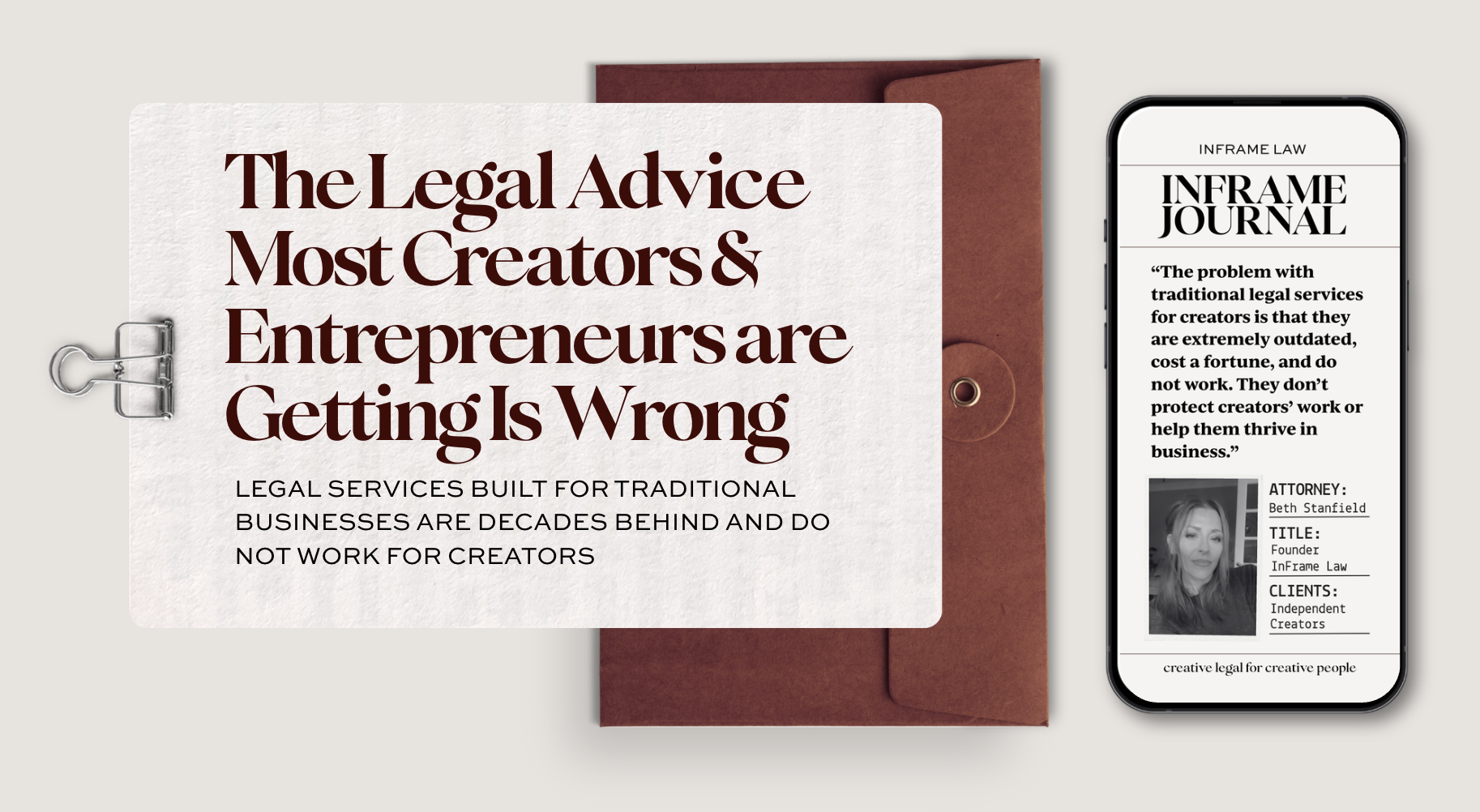
“The Legal Advice Most Creators & Entrepreneurs Are Getting Is Wrong.”
A VIEW FROM BOTH SIDES
Most creative entrepreneurs get the same legal advice, the same contracts, and the same intellectual property services traditional companies get. But for creators building business in the creator economy—writers, coaches, designers, and so many others—the traditional approach is the wrong approach.
Three years ago, I didn’t fully understand why traditional legal “solutions” weren’t working for my creative clients. Now I do.
The Backstory
In 2023, at the height of my legal career, I entered the creator economy to build a business around my own creative work. After almost two decades inside traditional law firms, I was prepared for a bit of whiplash. But what I actually experienced was more like a time-warp.
Virtually nothing about the traditional legal setting—or its services—reflects the reality of modern creative entrepreneurship.
After three years working exclusively in the creator economy, I now understand why. Creators do not want or need to do business the old way. They’ve cut ties with the traditional business world and are building businesses around their own bodies of work at a rate and scale we’ve never seen before. But the law firms and legal services they turn to are still decades behind.
The time-warp I experienced leaving the traditional legal world and entering the creator economy wasn’t a feeling, it was real. The numbers don’t die.
The Numbers
Twenty years ago, the creator economy barely existed. YouTube launched its Partner Program in 2007, and the ecosystem that followed has grown into a global market valued at over $200 billion. And that was before AI—before a multitude of high-powered aggregation and generative tools made building a business around creative work not only possible, but far more lucrative for independent artists and creators of all kinds.
Between 2020 and 2024 alone, the number of entrepreneurs earning full-time equivalent income went from 200,000 to 1.5 million and it’s not slowing down. What this means for the growing number of creators seeking legal protection for their work is this:
Most of the advice they get is stuck in old-world solutions and old-world services that were built for a different client and a different time. The creator economy has permanently moved on but the legal world has stayed the same.
More Than Numbers
What makes the creator economy so different is not just the number of creative entrepreneurs entering the market, it’s what creators are building, what they value, and how they work. I cannot overstate the importance of this distinction because it explains why traditional legal services do not work.
Creators aren’t selling traditional goods and services. Their business is their body of work—their brand, creative work, and content—collectively operating in the creator economy as an integrated whole.
YOUR BODY OF WORK
A creator’s business is neither built nor defined by what they sell. Everything revolves around the creator’s body of work—their content, artwork, articles, essays, courses, programs, offers, ideas, messaging, and brand elements—an and collectively represent the creator’s creative voice, business credibility, income potential, and cultural impact.
What makes creators’ body of work so unique isn’t just what it signifies in the market, but the way it operates.
It’s the creator’s most valuable asset, but it’s not a single product, a single service, a single transaction, or a single asset type. The components are produced in multiple art forms, exist in various mediums, and operate in constant motion across platforms, websites, inboxes, and applications.
From a legal perspective, a creator’s body of work is made up of three types of intellectual property assets: their 1) brand; 2) creative work; and 3) content. But because of the way these assets operate together, over a myriad of platforms and mediums, they cannot be protected with the same approach traditional law firms apply to traditional businesses.
WHY THE INTEGRATED APPROACH IS THE ONLY ONE THAT WORKS FOR CREATORS
Legal services for entrepreneurs and small businesses are built around a reactive model—identify the risk, draft or file around it, call your attorney when something goes wrong. That model has genuine utility for businesses where the primary assets are tangible and discrete. But for a fluid asset that operates as a comprehensive whole, like creators’ body of work, true legal protection must operate as fluidly and comprehensively as the work itself.
The standard legal approach treats the trademark and copyright components of the creator’s body of work as separate services—with separate engagements, separate attorneys, and separate invoices. Not only is this approach incredibly expensive and fragmented, it leaves the vast majority of assets completely exposed. Why?
Because the only way to protect assets like content, articles, essays, podcasts, videos, courses, offers, and programs is through industry-specific contracts and clear terms that are drafted by an attorney who understands the creative world.
This is why we don’t offer traditional IP services for creative entrepreneurs. It’s an outdated, piecemeal approach that costs a small fortune and does not work.
Traditional legal services are built around lawyers and the way law firms organize clients into specific areas of law. Our approach flips the traditional script. It’s built entirely around creative entrepreneurs, the way they work, and the way their assets actually operate in the creator economy.
Creators like you deserve better. You deserve legal protection that actually works. You deserve legal services that are clear, affordable, and easy to implement. But most of all, you deserve legal counsel that truly sees you, understands your world, and supports everything you do.
WHY INFRAME
InFrame Law protects the brand, creative work, and content of creative entrepreneurs. We do this through a single, affordable framework that integrates the trademark, copyright, and intellectual property services creators need to protect and position their work.
As a law firm built by creative entrepreneurs for creative entrepreneurs, we know what it takes to build an income-producing body of work in the creator economy. We know how that work operates over platforms and applications and how quickly and easily these assets can be copied, stolen, and misused.
Yet, no one is truly protecting creators’ work–not the platforms, not the applications, not the template shops, and definitely not the law firms. Creators are left to figure it out for themselves, leaving their most valuable assets completely exposed. Not because they’re careless or naïve, but because the available legal “solutions” come from old-world approaches that cost a small fortune and do not work. We know this–not just from 20 years of legal practice, but as creators just like you.
This is Why InFrame. We provide the legal solution that didn’t exist until now–complete asset protection for your brand, creative work, and content, in one framework that places your body of work exactly where it should be.