HOW INSTAGRAM, TIK-TOK & YOUTUBE ARE USING YOUR CONTENT & HOW TO REGAIN OWNERSHIP, CONTROL & PROTECTION OF YOUR WORK
KEY INSIGHTS
• Based on a single click to “accept the terms,” creators are giving platforms the right to copy, share, modify, and use their content and feed it to AI—without compensating creators or providing notice for how (or where) the content is being used.
• Most Platform Terms suggest that creators are retaining control and protection of their work, but they aren’t—not practically or legally. In fact, no one is truly protecting creators or their assets—not government agencies, not the tech industry, and certainly not the platforms themselves.
• Creators must protect themselves and the only way they can effectively do it is by having an INDEPENDENT structure for protecting their work that exists entirely separate from platforms and covers every type of creator asset in every format and location they exist.
Before we get into it, I need to call out the elephant in the room:
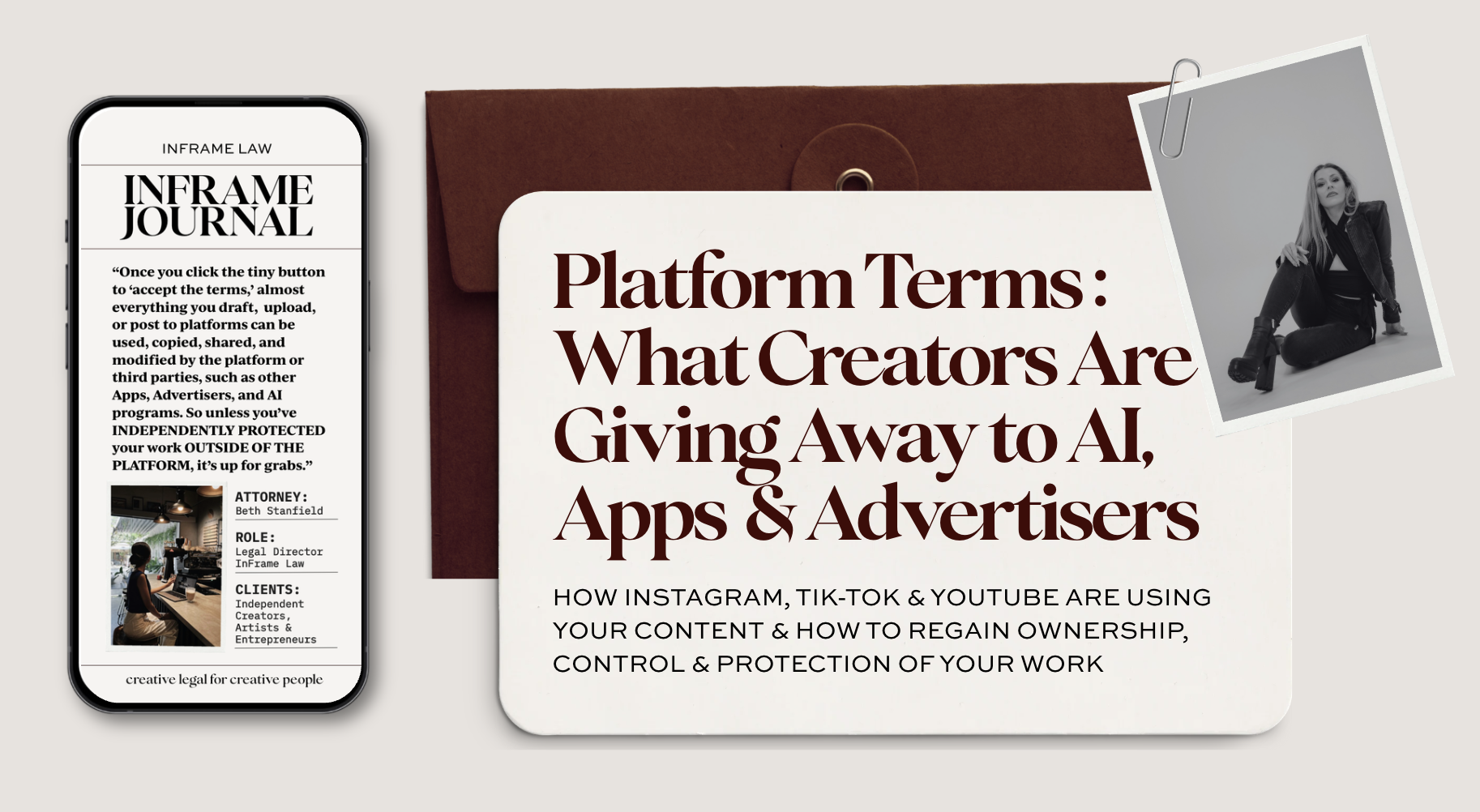
Platform Terms of Service: What Creators Are Giving Away to AI, Apps & Advertisers
We all do it.
We all click the button, accept the terms, and post our most valuable assets to the very platforms that were built to serve creative entrepreneurs like us. I do it too. Whether it’s Instagram, YouTube, TikTok, or even Substack, there’s only one way to participate and only one tiny little box to click for full platform access.
But since I’m a lawyer (and it’s my job to draft these terms), I did, in fact, read the T&Cs. Every interminable paragraph, every “including but not limited to,” and every sweeping relinquishment of my rights . . .
. . . and still clicked the button.
Just like we all do.
Because it’s not a negotiation—it’s part of the fixed fee for building business as a creative entrepreneur. That is, until one of us builds something better. But until then—here we are. So we might as well figure out how to work around the system. Because—yes—there is a way to work around the system. But creators need to understand what they’re giving to these platforms so they know how to protect themselves.
WHAT THE PLATFORMS ARE ACTUALLY DOING
In case you haven’t had a chance to curl up with a steaming cup of coffee, a cozy blanket, and some easy weekend reading called ALL THE PLATFORM TERMS YOU NEVER READ, I have a special gift for you.
One of my friends told me she’d rather poke an eye out than read the T&Cs so she asked me to give her a 90-second summary, and I said “okay.” Because, sure, the info is important, but not worth the loss of an eye. Or a cozy weekend.
So here’s what told her.
PLATFORM TERNS IN 90 SECONDS
Every major platform used by creators has its own Terms & Conditions (aka T&Cs aka Terms of Use aka Terms of Service, etc.), but they all serve the same core purpose: to outline legal rights and expectations between the platform and the user.
As you would expect, these terms are drafted with a high degree of technical detail—containing an obnoxious amount of legalese, unnecessary words, and more cross-references than the U.S. tax code. They’re also entirely one-sided and entirely non-negotiable.
They’re probably the mostboring documents you’ll (n)ever read, which seems intentional since they’re also some of the mostimportant documents you’ll (n)ever read. Here’s why.
When you click to accept the terms, a legally binding contract is formed that does two primary things:
Allows the platform to use your content (all the ways they may use, copy, or modify your content or share it with third party apps, advertisers, and AI programs); and
Limits the platform’s liability (all the ways they can’t be sued, all the losses they won’t cover, and all the things they won’t be responsible for once you draft, upload, or post anything on their platform).
Some of the platforms actually grant themselves a license to your content, which is a contractual method of transferring legal ownership of intellectual property. Other platforms avoid licensing language, preferring to ground their use of your content as a type of borrowing rather than a taking.
But the outcome is the same either way:
The moment you check the “accept the terms” box, almost everything you draft, create, upload, post, or provide the platform can, in some form or fashion, be used, copied, shared, displayed, and modified by the platform or third party contractors, such as Artificial Intelligence programs, apps, and advertisers.
This is how creators’ work can show up places they would never independently authorize—such as marketing materials the creator does not endorse—or fed by AI to downstream users who will use the work however they choose.
WHY THIS IS SUCH A BIG DEAL FOR CREATORS
The consequences for independent creators go far beyond any single piece of content. Creators aren’t just building a business. They’re building a business, a brand, and a livelihood through their writing, videos, art, courses, offers, ideas, products, programs, and all other creative content. And this collective group of intellectual property assets is not only the most valuable part of the creator’s business, it also represent the creator’s credibility, authority, and day-to-day income.
That’s why this is such a big deal for creators:their most valuable assets are also their most vulnerable assets. And most of it lives on major platforms with virtually no legal protection.
The platforms know this, so in their FAQs and marketing, they reassure creators with statements like: “You own what you create” and “Your work is protected under copyright laws”.BUT DO NOT BE DECEIVED.
OWNERSHIP AND PROTECTION OF CREATORS’ WORK IS NOT COMING FROM THE PLATFORMS. IT’S COMING FROM CREATORS—IF AT ALL.
No platform, no tech company, no AI program, no advertiser, no brand deal partner, no software, and no application is protecting your work. It’s the creator’s sole and independent responsibility.
And on this point the T&Cs are crystal clear: if something happens to your work, it’s on you. It will be your responsibility to prove ownership, regain control of your work, recover your losses, and do what you should have done all along:
Establish your own independent framework for owning, managing, and protecting your work online and everywhere else it shows up.
WHY THIS IS A “RIGHT NOW” ISSUE
For 20 years, I’ve served as a “first responder” when a client’s work has been ripped off by someone else, and I’ve walked with them through every stage of the process: from triage to surgery to rehab (and if they’re lucky) back to wholeness. But no matter how big or how small the business is, the loss is always devastating.
First, there’s the actual out-of-pocket cost of regaining ownership and control of stolen work (anywhere from 5K to over 200K). Then there’s the loss of time, energy, business credibility, and revenue. And finally, there’s the loss of “what could’ve been”—watching as someone copies your work, claims origination, and makes a killing, while the original creator struggles to be seen and valued for their work.
One of the more glaring examples is the Mel Robbins’ “Let Them” fiasco—a stark reminder of how easy it’s become for people with large audiences and big budgets to actively profit off the work of smaller creators—especially when there’s no identifiable framework or language protecting the creator’s work.
I’ve been outspoken about the Mel Robbins debacle because it’s unjust and infuriating. But it’s not a unique fact-pattern. It’s happening to small creators everywhere because they’re the ones producing the vast majority of quality creative content, but they’re also the ones who don’t take the necessary steps to protect it.
What this means for creators is is absolutely clear: to make it in the creator economy, they must implement an independent legal framework to protect their work.
WHY THIS IS A “RIGHT NOW” ISSUE FOR US TOO
I started writing about this problem after I first spoke out about Mel Robbins almost two years ago (see insta feed). But after a few months, I stopped writing and started researching. The problem was clear, but the solution was not. About nine months into the process, the pieces started coming together, and that’s when I started building.
I didn’t have the full picture when I started, but what I was building is the framework creators need right now—one that no one else is providing and that will allow creators to stay independent, stay creative, make a good living, and thrive.
The end result is the beautiful business I co-founded with my business partner. It’s called InFrame. It’s a law firm & contract shop that blends the three legal protections creators need—trademarks, copyrights, and creator-based contracts—in order to protect their assets, be seen in the market, and get paid for their work.
Nothing like InFrame exists on the market today, and nothing—nothing—lights me up more than using my own creativity and my own expertise to create what is needed but did not exist.
Well now it does. Come see.